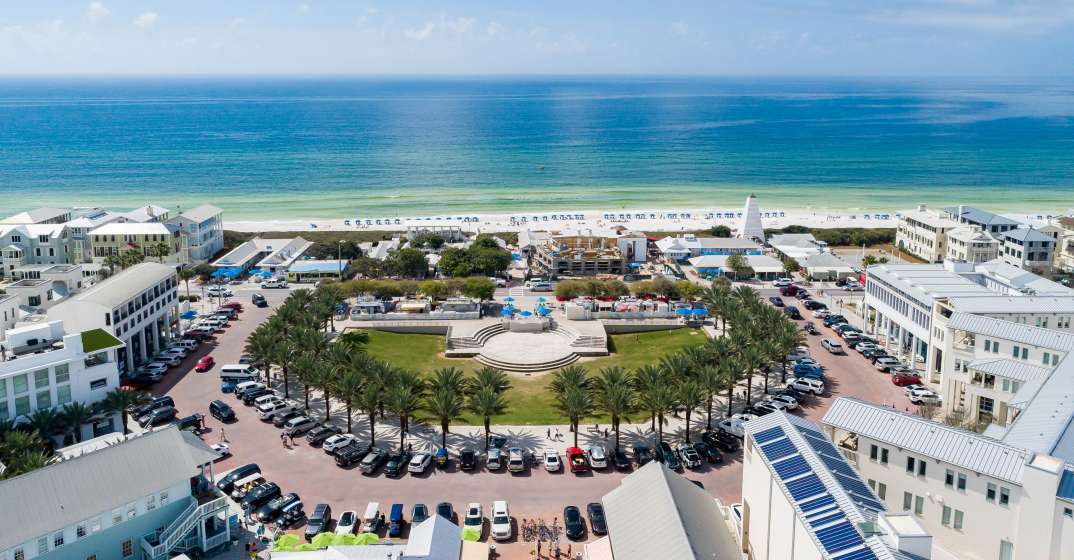
There are very few places in American real estate that carry the kind of cultural weight that Seaside, FL does. It was designed from scratch in the early 1980s as a demonstration of a new way of building towns — one that prioritized walkability, community life, and architectural coherence over the sprawl and car-dependency that defined most of postwar American development.
That experiment worked. Seaside became one of the most studied and imitated communities in the country, was featured in a major film, and helped launch the New Urbanist movement. Decades later, it remains one of the most sought-after addresses on 30A.
But for buyers seriously considering Seaside FL real estate, the history is only part of the picture. This guide covers what makes Seaside distinctive as a real estate market, who tends to buy here, and what to understand before you start your search.
How Seaside was built — and why it still matters for buyers
Seaside was developed by Robert Davis beginning in 1981 on 80 acres of Florida Panhandle land he inherited from his grandfather. Davis partnered with architects Andrés Duany and Elizabeth Plater-Zyberk to design a community from first principles: narrow streets, front porches set close to the sidewalk, shared civic spaces, a mixed-use town center, and strict architectural guidelines that dictated style, materials, and massing.
The result was a community where neighbors actually knew each other, where children could walk to the beach or the market without crossing a parking lot, and where the built environment itself encouraged the kind of public life that had been designed out of most American suburbs.
For buyers, this history has a direct practical consequence: Seaside's architectural standards have remained in place and actively enforced for over four decades. Every structure in the community meets those standards. There's no bad street, no poorly-designed house that undermines its neighbors. The coherence that was designed in has been maintained, and that coherence is a meaningful part of what holds value here.
What you'll find in the Seaside real estate market
Seaside is small — 80 acres total — which means inventory is inherently limited. You're not going to find dozens of active listings at any given moment. What you will find is a range of property types that reflect the community's design philosophy:
Cottage-style homes
are the most common property type. These are typically two to four bedroom homes with front porches, picket fences, and architectural details drawn from Florida Cracker, Victorian, and Carpenter Gothic traditions. They range in size from modest retreats to larger family homes, and their values depend heavily on location, lot size, and proximity to the beach walkovers.
Pavilion-area properties
near the central market and beach have premium positioning — close to the restaurants, shops, and the covered amphitheater that anchors Seaside's public life. These tend to command a premium and rarely sit on the market long.
Perdido Street and Ruskin Place
offer some of the community's more architecturally distinctive properties, including artist's studios and homes designed by notable architects during Seaside's early decades.
Rental cottages
operated through the Seaside rental program represent a significant portion of the market. Many buyers purchase here with the intention of using the property personally part of the year and renting it the rest. The demand for Seaside rentals remains strong and seasonal.
Because the community is so small and ownership turnover is low, off-market activity matters here. Having a local agent with relationships in the community is genuinely useful — not just a sales pitch.
The lifestyle: what it's actually like to own in Seaside
Seaside FL houses are most often described by their owners not in terms of square footage or amenities, but in terms of how they make you feel. That's not an accident — it's what the community was designed to produce.
Walking to the Airstream food trucks for breakfast. Biking the 30A trail to neighboring towns. Saturday mornings at the farmers' market on Ruskin Place. Catching a film at the open-air amphitheater. An evening walk to the beach in under five minutes. These are the rhythms of life in Seaside, and they're remarkably consistent whether you're a weekend visitor or a full-time resident.
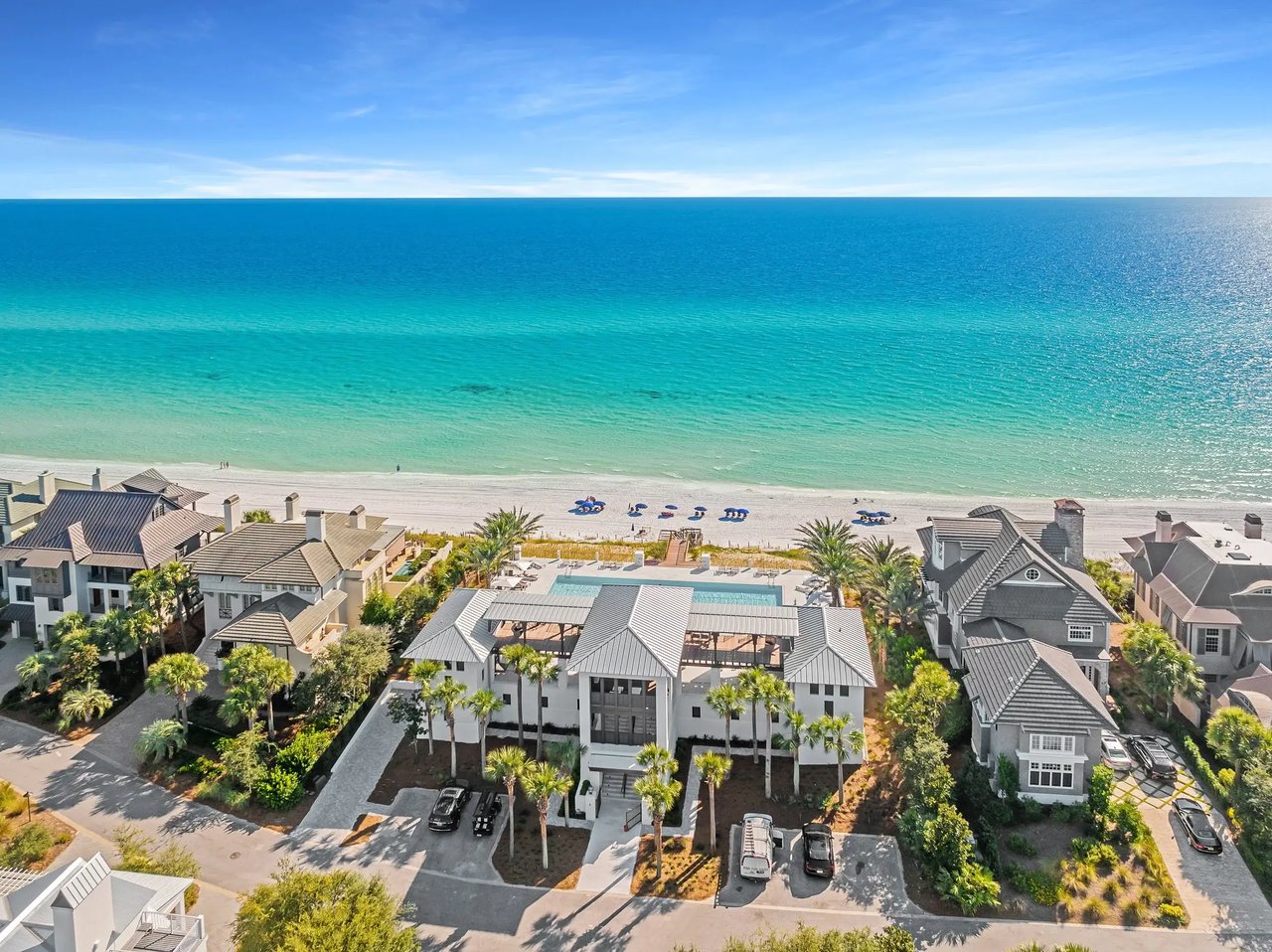
The beach in Seaside is public — accessed via community walkovers — which is different from communities like Rosemary Beach, where beach access is private. On busy summer weekends, this means Seaside's beach walkovers can be crowded with day visitors as well as owners. For some buyers this is a non-issue; for others it matters. Worth knowing before you decide.
The commercial center — restaurants, boutiques, the Modica Market — brings energy to the community year-round and is one of Seaside's most distinctive features. No other community on 30A has a walkable town center quite like it.
Who buys in Seaside
Seaside real estate attracts a distinct buyer profile that overlaps with — but is not identical to — the broader 30A market.
Architecture and design enthusiasts
are consistently drawn here. Seaside is genuinely interesting to people who care about how the built environment works, and ownership here feels like participation in something significant.
Long-term 30A families
often make Seaside their eventual home after years of vacationing along the corridor. The community's stability and strong sense of identity appeal to buyers who want to put down roots rather than rotate through properties.
Investment buyers
are present but tend to have a longer time horizon than in some other markets. Seaside's short-term rental income is real, but the buyers who succeed here are usually the ones who also genuinely want to be in the community, not just maximize yield.
Second-home buyers from design-conscious markets
Atlanta, Nashville, Birmingham, Charlotte — find in Seaside something that doesn't exist closer to home: a real town, built to human scale, on the Gulf of Mexico.
Seaside compared to neighboring communities
Buyers considering Seaside are often simultaneously looking at Watercolor to the west or Rosemary Beach to the east. Here's the honest comparison:
Seaside vs. Watercolor:
Watercolor is larger, has more organized amenities (pools, fitness, Western Lake), and a stronger short-term rental infrastructure. Seaside is more intimate, has a more iconic town center, and carries more architectural prestige. Watercolor tends to attract buyers who want amenity access; Seaside tends to attract buyers who want character and walkability. Explore Watercolor
Seaside vs. Rosemary Beach:
Both are New Urbanist communities with strict design standards, but Rosemary Beach draws from European coastal architecture while Seaside is rooted in American vernacular traditions. Rosemary Beach has private beach access; Seaside's beach is public. Rosemary Beach has a slightly more formal atmosphere; Seaside is a bit more casual and community-oriented in feel. For a deeper look at Rosemary Beach, see our guide.
For buyers who care about architecture and community design, the choice often comes down to personal aesthetic — and the best way to figure that out is to spend time in both.
What to know about the market
Real estate seaside FL has held its value well, reflecting both the community's limited size and the consistent demand from buyers who see Seaside as genuinely irreplaceable. The absence of available land for new construction means the inventory pool is fixed, and significant additions to supply are not coming.
Pricing reflects this scarcity. Entry-level cottages can be found below seven figures in the right circumstances, but much of the market operates in the $1M–$3M+ range depending on property size, location, and condition. Gulf-front and pavilion-adjacent properties trade at significant premiums.
Buyers should expect a relatively lean active inventory at any given time and should be prepared to move when the right property appears. Working with an agent who is actively monitoring the Seaside market — including off-market opportunities — is practical advice, not a formality.
For broader context on what's happening across the 30A luxury market, our 2026 buyer outlook post covers the picture in more detail. And for a comparison of how Seaside fits within the broader 30A community landscape, our Inlet Beach vs. 30A towns guide is a useful companion.
Ready to explore Seaside?
If Seaside is on your list — or if you're trying to decide whether it should be — our team is well-positioned to help. We work across all of the 30A communities and can give you an honest comparison of what's available and where you're likely to find the right fit.
Browse the Seaside neighborhood
Or reach out to our team directly. We're 30A locals who know these communities in the way that matters for buyers — not just the listings, but the streets, the history, and the nuances that don't show up on a property sheet.